
All abbreviations, terminology, and jargon related to returns explained

In this Wiki, we have complied a list of all the concepts, topics and terminologies about returns. Learn everything there is to know from the experts.

Sort
28
 items

Track & Trace

Track & Trace is a system used to track and monitor parcel shipments.

Read more

Supply Chain Management

Supply chain management is the process of planning, implementing, and controlling the flow of goods, services, and information from raw materials to the end user.

Read more

SKU

A SKU (Stock Keeping Unit) is a unique identification code used internally to distinguish a specific product or item within an inventory or store. It is used for tracking stock, identification, and product management.

Read more

Return conditions

Return conditions are the requirements a return must meet to be accepted, such as the condition of the product, the packaging, and the return period.

Read more

Return period

The return period begins once the customer exercises their right of withdrawal and returns the product. This is the timeframe during which the customer can actually send the product back to the webshop.

Read more

Return flow

The return flow is the movement of returned products throughout the entire chain of reverse logistics.

Read more

Return status

Return status refers to the current stage or phase of a returned product within the return process, such as "received," "in progress," "processed," "exchanged," "replaced," or "refunded."

Read more

Return reason

A return reason is the explanation a customer provides for returning a product, for example, because it is damaged, does not meet expectations, or is the wrong size or color.

Read more

Returns process

A returns process is the procedure by which a product is sent back to a store or fulfillment center, encompassing the steps required to return, inspect, and process the item, as well as to arrange any necessary refunds or exchanges.

Read more

Return rate

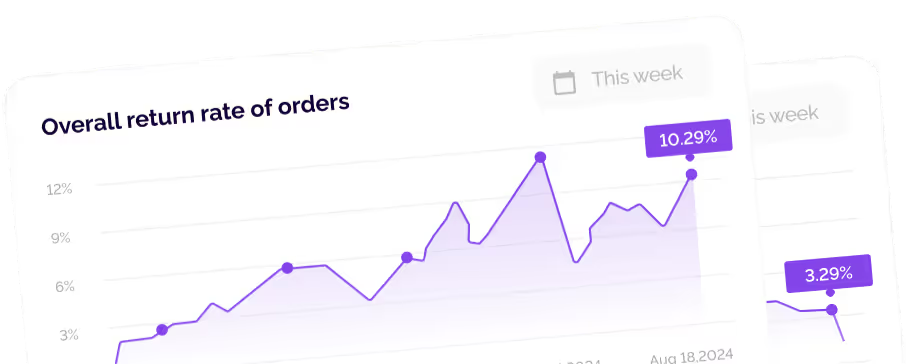
The return rate is the percentage of sold products that are returned by customers.

Read more

Reverse logistics

Reverse logistics refers to the process of managing product returns from customers.

Read more

Return label

A return label is a label or sticker attached to a package to identify the return shipment.

Read more

Return costs

Return costs are the expenses incurred when a customer sends a product back to a seller or online store, such as shipping and processing fees.

Read more

Return form

A return form is a document that customers fill out to return a product.

Read more

Returns experience

Returns experience refers to the overall impression your customer has when returning a product.

Read more

Return policy

A return policy is a company policy that determines how customers can return, exchange, or get a refund for products, and provides information on the terms and procedures for returns, with the goal of improving customer satisfaction and loyalty and saving on costs.

Read more

Retention Rate

The retention rate is the metric for maintaining satisfied customers and revenue within the returns process by looking at the number of repeat purchases and accepted refunds.

Read more

Refund rate

A refund rate is a metric that measures the number of returns that result in a refund.

Read more

Perfect Order Rate

The perfect order rate is a metric that measures the efficiency and accuracy of the order fulfillment process. It represents the percentage of orders delivered on time, complete, undamaged, and with accurate documentation, which often leads to customer satisfaction.

Read more

Exchange process

An exchange process is a procedure where you swap a customer's purchase for a different product, rather than issuing a refund as you would with a standard return.

Read more

No fault found rate

The no fault found rate indicates the extent to which returned items are received in perfect condition, allowing them to be resold at the original price.

Read more

Right of withdrawal

The right of withdrawal is your customer's right to cancel an online purchase within 14 days, or longer if you promise this in your return policy, and return the product without needing to provide any reason for the return.

Read more

Exchange Rate

The exchange rate is a metric that measures the number of exchanged items relative to the total number of returned items over a specific period.

Read more

EAN code

An EAN (European Article Number) is an internationally recognized barcode used to identify and track products in e-commerce, retail, and the supply chain.

Read more

E-commerce platform

An e-commerce platform is software used by online retailers to manage their online sales operations. It provides features such as product management, order management, payment processing, and customer relationship management.

Read more

E-commerce customer journey

An e-commerce customer journey encompasses all the steps and interactions a customer goes through when discovering, researching, purchasing, and using a product from an online store. The goal of mapping the customer journey is to better understand and improve the customer experience.

Read more

Cooling-off period

The cooling-off period is a timeframe during which your customer can cancel an online purchase without providing a reason. In Dutch e-commerce, there is a statutory minimum cooling-off period of 14 days after receipt of the product.

Read more

BNPL

Buy now pay later (BNPL) is a payment option that allows consumers to pay for their purchases (in part) at a later date, usually without interest or fees.

Read more
Thank you! Your submission has been received!
Oops! Something went wrong while submitting the form.

Join Returnista today

Getting a grip on your returns is a driving factor of your success. It’s time for action. It’s time for Returnista

Schedule a demo